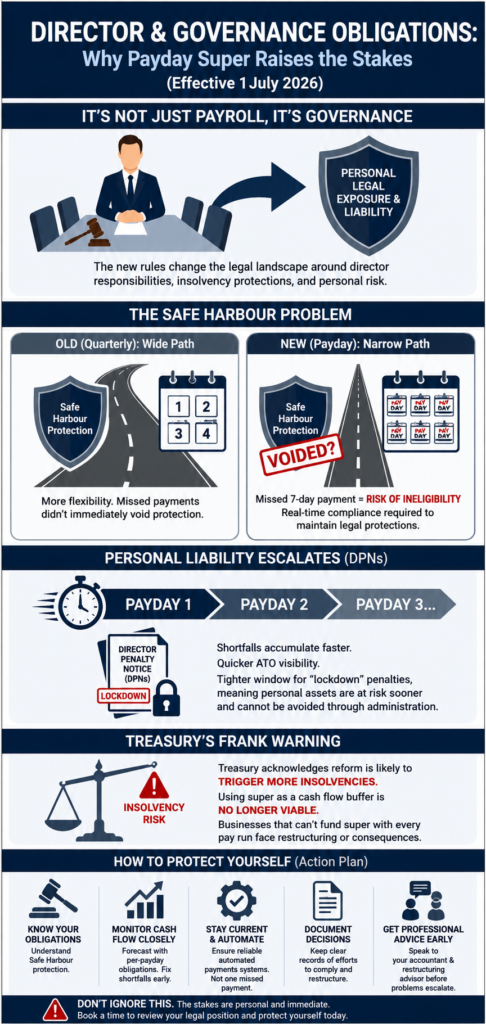
If you’re a director of a small business, Payday Super isn’t just an HR or payroll issue. It’s a governance issue that could directly affect your personal legal exposure.
The new rules don’t just change how super is paid — they change the legal landscape around director responsibilities, insolvency protections, and personal liability.
The Safe Harbour Problem
Under Australian insolvency law, directors have a duty to prevent a company from trading while insolvent. The Safe Harbour provisions under the Corporations Act provide some protection — they allow directors to continue trading while pursuing a restructuring plan, provided certain conditions are met.
One of those conditions is that employee entitlements are being paid on time. And from 1 July 2026, super is front and centre.
Under Payday Super, if your company is not paying super contributions within seven business days of each payday, you may not be eligible for Safe Harbour protection. This is a significant change. Previously, with quarterly deadlines, there was more flexibility. Now, every missed payday super payment could undermine your ability to rely on Safe Harbour if your business faces financial difficulty.
For directors of businesses with fluctuating revenue or tight cash flow, this creates a much narrower path. You need to be meeting super obligations in real time to maintain your legal protections.
Personal Liability for Directors
Directors should also be aware of the director penalty regime. Under existing law, the ATO can issue Director Penalty Notices (DPNs) to recover unpaid super. If super goes unreported or unpaid for more than three months, the penalty becomes “lockdown” — meaning it can only be discharged by paying the full amount.
It cannot be avoided through voluntary administration or liquidation.